
Introduction
The finishing method you choose for metal components directly affects field performance, lifecycle cost, and production throughput. For fabricators and OEM manufacturers working with structural steel, industrial equipment, or architectural components, it's an operations decision—one that drives warranty claims, rework rates, and customer satisfaction.
Both powder coating and spray painting are proven finishing methods with legitimate industrial track records. But they deliver very different results when measured against key production criteria: coating durability, lifecycle cost, production consistency, and environmental compliance. Choose the wrong process, and you'll deal with premature finish failure, increased field touch-ups, and higher total cost of ownership.
This guide breaks down both processes side by side, explains where each method wins, and helps manufacturers and fabricators make the right call based on substrate type, performance environment, and production requirements.
TL;DR
- Powder coating is an electrostatically applied dry finish cured at 300–400°F, producing a thicker, more corrosion-resistant coat than spray paint
- Spray paint works on non-metal substrates and offers more color flexibility, but degrades faster and needs more frequent recoating
- Powder coating lasts 15–20+ years vs. spray paint's 2–5 year service life, making it the lower-cost option over time
- Spray painting suits thin coatings, non-conductive materials, or parts that can't withstand oven curing
- Powder coating is the default choice for most metal fabrication work; substrate type, volume, and environment determine the final call
Powder Coating vs. Spray Painting: Quick Comparison
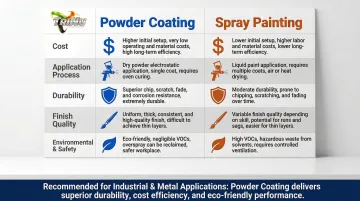
| Criterion | Powder Coating | Spray Painting |
|---|---|---|
| Cost | Higher upfront per-part cost; lower lifecycle cost due to durability and minimal rework. Material utilization reaches 95–98% with reclaim systems, vs. 30–50% for liquid spray — cutting applied material costs by up to 50%. | Lower upfront cost, but higher long-term expense from repainting, touch-ups, and shorter service life in demanding environments. |
| Application Process | Dry powder applied electrostatically at 40,000–100,000 VDC; oven-cured at 300–400°F for 10–30 minutes. Requires conductive (metal) substrates for electrostatic grounding. | Liquid paint sprayed via pneumatic gun; air-dries or bakes. Works on metal, plastic, wood, and other non-conductive substrates. |
| Durability | Coating thickness typically 2–6 mils in a single pass. Highly resistant to chipping, cracking, UV exposure, and corrosion. Passes 500–1,000+ hours in salt spray testing (ASTM B117); AAMA 2605-compliant coatings withstand 4,000 hours. | Thickness typically 0.5–1 mil per coat; requires 3–4 coats to approach powder coating build. More prone to chipping, fading, and degradation over time. |
| Finish Quality | Smooth, consistent finish with no drips or sags when properly applied. Limited orange peel risk with correct gun settings and cure parameters. Fewer color options than liquid paint. | Wider color range including custom mixing and spot color matching. Easier field touch-ups. Higher risk of uneven coverage, runs, and sags without skilled application. |
| Environmental & Safety | No VOCs, no solvents. Overspray collected and reused — near-zero waste. Lower fire and inhalation risk. Bypasses EPA air permitting and OSHA 1910.107 hazardous storage requirements. | Contains VOCs and solvent carriers. Higher fire and inhalation risks. Stricter storage, ventilation, and disposal requirements under EPA NESHAP and OSHA regulations. |
What is Powder Coating?
Powder coating is a dry finishing process in which electrostatically charged powder particles—made of resins, pigments, and additives—are sprayed onto a grounded metal surface and then cured in an oven. Common resin types include epoxy, polyester, urethane, and hybrid blends.
During the curing step, the powder melts, flows, and chemically cross-links into a solid coating that bonds directly to the substrate. This curing process—typically 10–30 minutes at 300–400°F peak metal temperature—creates a harder, more adhesive finish than any air-dried paint can achieve.
Key Resin Types and Their Tradeoffs:
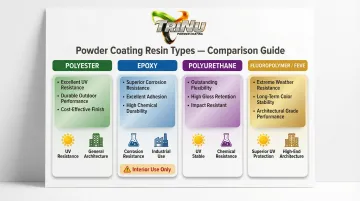
| Resin Chemistry | Primary Characteristics | Recommended Applications |
|---|---|---|
| Polyester | Excellent UV stability, hardness, weatherability | Outdoor applications, architectural components, fencing |
| Epoxy | Superior chemical and corrosion resistance; rapid gloss loss and chalking under UV | Interior applications only, under-hood automotive, primers |
| Polyurethane | Superior UV resistance, flexibility, chemical resistance | Outdoor furniture, automotive components, agricultural equipment |
| Fluoropolymer (FEVE) | Ultra-high-performance UV resistance; withstands extreme radiation | Premium architectural exteriors requiring AAMA 2605 compliance (10–20+ years) |
For manufacturers in coastal or high-humidity environments, proper resin selection is critical. Epoxy powders must never be used as exterior topcoats—they chalk and degrade rapidly under sunlight. Super-durable polyesters and fluoropolymers are strictly recommended for UV-exposed applications.
Resin selection only goes so far, though. Powder adhesion depends equally on clean, properly prepared surfaces—degreasing, cleaning, and often sandblasting. Skipping or rushing prep is the most common cause of coating failure, regardless of which finishing method you use.
Use Cases of Powder Coating
Powder coating fits naturally into batch production environments. Parts move through a defined sequence—prep, coat, cure—making it highly compatible with manufacturing workflows that require controlled processes and documented quality.
Dominant application areas include:
- Architectural metalwork and structural steel components
- Industrial equipment frames and fabricated assemblies
- OEM manufactured parts requiring specification-ready finishes
- Outdoor fixtures, railings, gates, and fencing
- Automotive components and underbody parts
- Marine-grade applications requiring corrosion resistance
For manufacturers in coastal environments like Florida, powder coating's corrosion barrier and UV resistance translate to fewer warranty claims, less rework, and longer service life—real advantages when parts face salt air, humidity, and intense sun exposure every day.
What is Spray Painting?
Spray painting is a liquid-based finishing process where paint—a mixture of pigments, binders, and solvents (VOCs)—is atomized through a spray gun and applied to a surface. The solvent evaporates during air drying or is driven off through baking, leaving a cured film. It remains widely used because the equipment is accessible and the process handles substrates powder coating can't.
Compared to powder coating, spray painting has real trade-offs:
- Requires multiple coats to build adequate protection (0.5–1 mil per pass)
- Produces more runs, sags, and uneven coverage without careful technique
- Introduces VOC handling, storage, and compliance overhead
That said, certain jobs genuinely favor spray painting over powder:
- Non-metallic substrates (plastic, fiberglass, wood) that can't be grounded for electrostatic application
- Parts with tight dimensional tolerances that can't accept the thicker build of powder
- Custom or spot color matching that falls outside standard powder options
- Touch-up and field repair work where oven curing isn't practical
Use Cases of Spray Painting
Spray painting is the practical choice in several production scenarios:
- Custom or low-volume runs requiring colors outside standard powder options
- Repairs and touch-ups on already-assembled equipment
- Components made from non-conductive substrates
- Parts that can't fit in a curing oven, whether due to size or complexity
Even in powder-coat-dominant shops, spray painting shows up as a secondary process—handling masked areas, spot repairs, or anything that can't go back into the oven after assembly.
Powder Coating vs. Spray Painting: Which is Right for Your Operation?
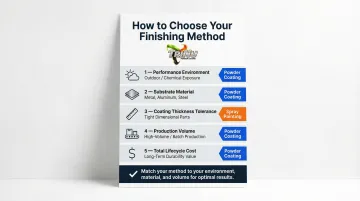
The right finishing method depends on five decision factors industrial buyers should evaluate:
1. Performance Environment
Indoor/controlled environments tolerate spray paint's lower durability. Outdoor/coastal/UV-exposed applications demand powder coating's superior corrosion and UV resistance.
2. Substrate Material
Conductive metal substrates (steel, aluminum, stainless steel) are ideal for powder coating. Non-metallic substrates require spray paint or specialized pretreatment.
3. Coating Thickness Tolerance
Functional surfaces with tight fits may not accept powder coating's 2–6 mil build. Open structural components benefit from thicker, more durable powder coatings.
4. Production Volume and Throughput
Batch production benefits from powder's single-coat efficiency and faster processing times. Low-volume or custom color runs may favor spray paint's flexibility.
5. Total Lifecycle Cost
Research shows powder coating lasts 15–20+ years outdoors with proper prep, while spray paint typically requires repainting every 2–5 years in harsh conditions. When repainting frequency, downtime, rework, and field failures are factored in, the total cost of ownership often reverses in powder coating's favor.
Two additional factors often tip the decision at the operational level:
- Regulatory compliance: Manufacturers under EPA and OSHA requirements benefit from powder coating's zero-VOC profile. Solvent storage, application ventilation, and waste disposal permitting can add significant complexity and cost to spray paint operations.
- Process consistency: Powder coating's electrostatic application and oven curing produce repeatable results. Thickness, adhesion, and surface quality are easier to verify batch to batch — wet spray is more operator-dependent and sensitive to humidity and temperature.
Situational recommendations:
- Choose powder coating when you need maximum durability, corrosion resistance, production consistency, or are finishing conductive metal parts at volume
- Choose spray painting when working with non-metallic substrates, when parts require tight dimensional tolerances, when field touch-ups or spot repairs are needed, or when color customization flexibility outweighs durability requirements
Real-World Applications: When the Right Finish Makes a Difference
A fabricator producing structural steel components for outdoor installation initially used spray painting to finish parts. Within 18 months, premature coating failure appeared—particularly on parts exposed to weather and high-wear environments. Customer complaints increased, rework rates climbed, and warranty repairs became a recurring cost burden.
The trigger for switching to powder coating was simple: the lifecycle cost of repeated repainting and warranty repairs exceeded the higher upfront cost of powder coating. More importantly, consistent, production-grade finishing was needed to support reliable delivery schedules and eliminate rework loops.
Link 51 Shelving, a UK-based steel storage manufacturer, achieved measurable results after transitioning from liquid to powder coating:
- 50% reduction in applied material cost (from £0.47/m² to £0.23/m²)
- 70% reduction in rework rates
- £2,000–3,000 in monthly savings from decommissioning paint pot compressors
These outcomes reflect the production efficiency and quality consistency powder coating delivers in real manufacturing environments.
Results like these aren't limited to large UK operations. Tampa Bay manufacturers and fabricators are making the same transition for the same reasons.
TriNu Powder Coating handles surface prep, application, curing, and pickup/delivery from a single facility in New Port Richey—with a 10' × 10' × 30' production oven built for industrial volume. Contact us at (727) 316-6700 or service@trinupowdercoating.com to discuss your project.
Conclusion
Neither method is universally superior. Here's where each method holds its own:
Powder coating is the stronger choice for:
- Metal fabrication and manufacturing parts requiring durability
- High-volume production runs where consistency matters
- Corrosion resistance and long-term cost efficiency
Spray painting remains the practical option for:
- Non-metallic substrates that can't be electrostatically charged
- Touch-up work and field repairs
- Tight-tolerance parts where coating thickness is critical
- Projects demanding broad color flexibility or fast color changes
For manufacturers and fabricators, the finishing method is a production decision with downstream effects on product quality, maintenance costs, and schedule reliability. Choosing the right process—and the right finishing partner—is what separates consistent results from recurring rework. If your operation runs on powder coating, TriNu Powder Coating works with manufacturers and fabricators across the Tampa Bay area to deliver process-driven finishes you can plan around — call (727) 316-6700 or reach out at service@trinupowdercoating.com.
Frequently Asked Questions
What is the average cost to powder coat?
Material costs for powder coating average ~$0.21 per square foot compared to ~$0.52 per square foot for liquid polyurethane paint—though final pricing varies by part size, complexity, and volume. The longer service life typically makes powder coating the more cost-effective option over time.
Is it better to spray paint or powder coat?
For most industrial metal parts, powder coating is the better choice due to superior durability, corrosion resistance, and production consistency. Spray painting is better suited for non-metal substrates, tight tolerances, field repairs, or custom color needs.
Can you spray paint over powder coating?
Yes, spray paint can be applied over powder coating—typically for touch-ups or repairs—but the surface must be properly sanded and cleaned first to ensure adhesion. It's the go-to option when re-baking isn't possible on-site.
How long does powder coating last compared to spray paint?
Powder coating lasts 15–20+ years with proper prep and application, while spray paint on industrial parts typically requires touch-up or full recoating within 2–5 years depending on exposure conditions.
What metals can be powder coated?
Most conductive metals can be powder coated, including steel, aluminum, stainless steel, and iron. The substrate must be electrically grounded for electrostatic application to work—non-conductive materials like plastic or wood require special pretreatment first.
Does powder coating require special surface preparation?
Yes, surface prep is critical—parts must be cleaned, degreased, and often sandblasted or chemically treated before coating to ensure proper powder adhesion. Inadequate prep is the leading cause of powder coating failure regardless of application quality.
![Powder Coating Bumper: Total Cost Breakdown & Pricing Guide [2026]](https://file-host.link/website/trinupowdercoating-kp0fq9/assets/blog-images/d0779c55-8f64-4063-a95c-43969e8f015c/1775735472870451_26214f3797cf46bca14f277761db5353/1080.webp)