
Introduction
Precision manufacturers and fabricators face a real cost when they get coating selection wrong: premature field failures, dimensional issues from excess film build, and rework that stalls production schedules.
The coating you specify does more than protect appearance. It directly affects corrosion resistance, hardness, UV stability, and how well the part holds up through its entire service life.
Powder coating has become the go-to industrial finishing method for metal parts because it cuts VOC emissions, applies uniformly on complex geometries, and outperforms liquid paint in film hardness. But choosing the right chemistry takes more than picking a color. Each finish type — epoxy, polyester, hybrid, TGIC-free — carries distinct trade-offs in UV stability, chemical resistance, and application behavior that must match your part's operating environment.
Here's what you need to know to match the right finish to your parts — and your production requirements.
TLDR
- Powder coating finishes for precision metal parts fall into five main categories: polyester, epoxy, epoxy-polyester hybrid, polyurethane, and specialty textured finishes
- Polyester offers the best all-around versatility for interior and exterior use; epoxy leads for indoor corrosion protection but breaks down quickly outdoors
- Polyurethane delivers premium mechanical performance and color retention for high-wear or cosmetically critical parts
- Specialty textured finishes hide surface imperfections and hold up well in harsh or high-contact environments
- Every powder coating adds roughly 0.003" of thickness per side—factor this into your tolerance specs before finishing begins
Why Finish Type Matters for Precision Metal Parts
Powder coating is a dry finishing process that uses polymer resin systems, curatives, and pigments applied electrostatically and cured into a continuous film via heat. For precision parts—components with tight tolerances, complex geometries, and controlled surface specifications—finish selection is more critical than for general fabrication work.
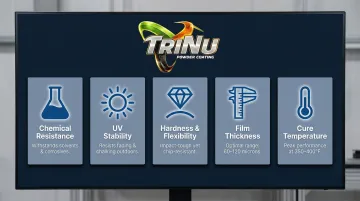
The key performance variables that differentiate finish types include:
- Chemical resistance - How well the coating withstands solvents, acids, and industrial chemicals
- UV stability - The coating's ability to resist chalking, yellowing, and gloss loss under sunlight
- Hardness and flexibility - Balance between scratch resistance and the ability to withstand bending stress
- Film thickness - Standard powder coatings add 60-120 microns (2.4-4.7 mils), affecting dimensional accuracy
- Cure temperature - Typically 350-400°F, which can affect heat-sensitive assemblies
Beyond chemistry, surface texture—gloss level, sandtex, matte—and application process interact with part geometry. The Faraday cage effect is a direct consequence of this: electrostatic field lines follow the path of least resistance, leaving internal corners and deep profiles with thin or missing coverage.
Film thickness also affects dimensional accuracy directly. Powder coating adds approximately 0.003" per side (0.006" total on a given dimension), which must be accounted for in part design to avoid assembly issues.
Top Powder Coating Finishes for Precision Metal Parts
These five finish types represent the primary options evaluated by manufacturers and fabricators for precision metal components, selected based on protective performance, application reliability, substrate compatibility, and fit for industrial production environments.
Polyester Powder Coating
Polyester is the most widely specified finish in industrial manufacturing, offering a practical balance of UV resistance, mechanical durability, and cost-effectiveness. It's the default choice for both interior and exterior precision parts across OEM, fabrication, and architectural applications because it performs reliably in diverse environments without requiring premium pricing.
Polyester delivers several performance advantages critical to precision manufacturing:
- Low cure temperature (340-400°F) reduces thermal stress on sensitive assemblies
- Flexibility resists cracking on parts subject to assembly stress—withstanding up to 160 in-lbs of impact and passing a 180° bend test without failure
- UV stability meeting AAMA 2604 standards, with maximum 5 Delta E color fade and minimum 30% gloss retention after 5 years of Florida exposure
- Broad color and gloss range supports both functional and branded finish requirements
The limitation: polyester is less effective than epoxy for parts exposed to aggressive chemical environments. Exposure to harsh solvents like Acetone or MEK causes dulling and softening within 1 hour.
| Category | Details |
|---|---|
| Best Application | Interior and exterior precision parts, architectural components, OEM assemblies, high-volume production runs |
| Key Technical Properties | Strong UV stability, good impact and chemical resistance, low cure temperature, wide color and texture availability |
| Precision Part Considerations | Adds approximately 0.003" per side; compatible with most metal substrates; preferred finish when both durability and cost control are required |
Epoxy Powder Coating
Epoxy provides the highest-performing finish for corrosion and chemical resistance in controlled indoor environments. During cure, it forms hard, dense bonds that deliver superior protection against moisture, solvents, and industrial chemicals—making it the preferred choice for electrical enclosures, machine components, and precision parts operating in corrosive indoor settings.
Salt spray testing demonstrates epoxy powders can achieve 3,000 to 7,000 hours of resistance over properly blasted steel substrates.
Epoxy's hardness and chemical resistance come with a critical trade-off: it degrades rapidly under UV exposure, chalking and yellowing within months of outdoor use. This restricts epoxy to interior applications or use as a primer beneath weatherable topcoats. Additionally, epoxy typically requires higher cure temperatures relative to polyester, which may affect heat-sensitive assemblies.
For parts requiring tough, abrasion-resistant interior finishes—particularly in chemical processing, marine equipment housings, or moisture-heavy industrial environments—epoxy's 2H to 4H pencil hardness and exceptional barrier protection make it the right choice.
| Category | Details |
|---|---|
| Best Application | Indoor machine housings, electrical enclosures, precision parts in chemical or moisture-heavy environments |
| Key Technical Properties | Highest corrosion and chemical resistance of standard powder types, excellent hardness and adhesion, limited UV stability |
| Precision Part Considerations | Not suitable for outdoor or UV-exposed parts; film thickness must be controlled carefully on close-tolerance features; ideal over sandblasted substrates |
Epoxy-Polyester Hybrid Powder Coating
Hybrid coatings blend epoxy resins with polyester resins to combine epoxy's hardness and adhesion with polyester's flexibility and broader environmental tolerance. The ratio of epoxy to polyester in the formulation determines where performance lands on the durability-to-aesthetics spectrum:
- Higher epoxy content increases hardness and chemical resistance
- Higher polyester content improves UV stability and flexibility
Hybrids are commonly specified for high-use industrial equipment, power tools, and assemblies that require both appearance consistency and wear resistance without the cost premium of polyurethane.
Hybrid coatings can inherit limitations from both parent chemistries depending on blend ratio. Epoxy-heavy blends may exhibit partial UV sensitivity, chalking after 6-12 months of continuous outdoor exposure. Polyester-heavy blends may show reduced chemical resistance compared to pure epoxy. Testing shows hybrids typically pass 250 hours of salt spray but are recommended for indoor use where weathering resistance is not critical.
Hybrids provide a practical middle-ground for manufacturers who need reliable general-purpose performance for office furniture, HVAC equipment, appliances, and indoor fabrications.
| Category | Details |
|---|---|
| Best Application | High-use industrial equipment, power tools, assemblies requiring balanced wear resistance and finish consistency |
| Key Technical Properties | Combined hardness and flexibility, good general durability, moderate UV and chemical resistance depending on blend ratio |
| Precision Part Considerations | Performance varies by epoxy-to-polyester ratio; verify blend specification with coater before finalizing for outdoor or chemically aggressive environments |
Polyurethane Powder Coating
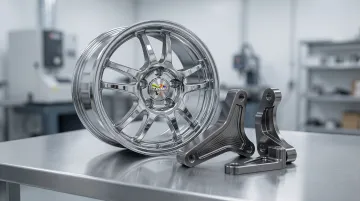
Polyurethane delivers the strongest mechanical performance across standard powder coating chemistries: chip resistance, scratch hardness (H to 5H pencil hardness), and long-term color retention. It's the preferred finish for precision parts where cosmetic quality and surface integrity are both specification requirements—automotive components, wheel rims, and high-visibility OEM assemblies.
Polyurethane excels in outdoor and high-wear environments, providing excellent thin-film appearance, high gloss (75+), and superior weatherability. When properly applied over prepared and primed substrates, it delivers measurably better performance than polyester or hybrid options.
The trade-offs: polyurethane carries higher material cost and generates odor and smoke during cure due to the release of blocked isocyanate crosslinkers. Cure processes typically require 15 minutes at 375-400°F, and the outgassing requires proper ventilation in the coating facility with appropriate respiratory protection for operators.
For precision parts where surface quality is a specification requirement—agricultural equipment, construction machinery, public transport components, premium outdoor furniture—polyurethane's performance in demanding environments justifies the premium.
| Category | Details |
|---|---|
| Best Application | Automotive parts, high-wear precision components, exterior OEM assemblies requiring long-term color and surface integrity |
| Key Technical Properties | Excellent chip, scratch, and UV resistance; high gloss retention; superior mechanical hardness over polyester and hybrid options |
| Precision Part Considerations | Higher cost; requires ventilated cure environment; best applied over properly prepped and primed substrates for maximum adhesion on precision parts |
Specialty Textured and Sandtex Finishes
Specialty textured finishes—including sandtex, hammertone, wrinkle, and fine-texture powders—provide functional performance advantages beyond aesthetics. Texture hides surface variation on fabricated or welded parts, conceals minor pinholes in die-cast components, provides fingerprint and scratch resistance, and improves grip on handles and enclosures. Sandtex finishes are the most durable of all powder types for outdoor and high-abuse environments.
Textured finishes are particularly useful when substrate surface condition is inconsistent—common after welding or sandblasting—and when gloss finishes would amplify imperfections. Fine and rough textures effectively mask machining marks, rough welds, and die-cast porosity that would be visible through smooth coatings.
Performance testing shows sandtex finishes maintain excellent mechanical properties: ≥160 in-lbs impact resistance, 5B adhesion, and 500+ hours salt spray resistance.
Monitoring thickness on textured coatings is critical. Peaks and valleys in the texture mean standard gauges read from peaks to substrate, leaving thinner coating in recessed areas. ASTM D7091 notes that surface texture creates a "background value" requiring base metal reading (BMR) compensation. To ensure adequate corrosion protection in valleys, textured powders must be applied at a minimum film thickness of 3.0-4.0 mils (80-100 µm)—thicker than smooth finishes.
| Category | Details |
|---|---|
| Best Application | Welded assemblies, die-cast precision parts, outdoor enclosures, equipment handles and housings requiring durability and imperfection concealment |
| Key Technical Properties | Highest durability among powder types; excellent slip, impact, and fingerprint resistance; available in matte to semi-gloss range |
| Precision Part Considerations | Film thickness must be verified at valley depth, not just peaks; surface preparation quality remains critical for long-term performance |
How We Chose the Best Powder Coating Finishes for Precision Metal Parts
These five finish types were evaluated based on criteria most relevant to precision manufacturing and industrial production: corrosion and chemical protection, UV and thermal stability, dimensional impact (film thickness and tolerance management), compatibility with common metal substrates (steel, aluminum, galvanized), and suitability for production environments where precision parts are used.
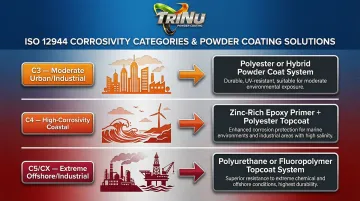
Selection frameworks like ISO 12944 corrosivity categories match finish chemistry to environment severity:
- C3 (moderate urban/industrial): Polyester or hybrid powder coat
- C4 (high-corrosivity coastal): Zinc-rich epoxy primer plus polyester topcoat
- C5/CX (extreme offshore or industrial humidity): Polyurethane or fluoropolymer topcoat systems
Surface Preparation Is Equally Critical
Finish selection alone does not guarantee performance. How well any coating bonds depends on the quality of surface preparation that precedes it. High-performance powder coatings require abrasive blasting to SSPC-SP 10 / Sa 2.5 (Near-White Metal Blast) or SSPC-SP 5 / Sa 3 (White Metal Blast) standards.
Proper degreasing, removal of mill scale and rust, and surface profiling through sandblasting or chemical pretreatment create the mechanical anchor profile that promotes adhesion and prevents outgassing blisters.
Working with an industrial powder coater that follows a process-driven approach ensures the right finish is paired with the right preparation method for each part type. TriNu Powder Coating's structured workflow covers material-specific prep selection (chemical etching, mechanical etching, or sandblasting), controlled blasting parameters, and quality verification checkpoints before coating application begins.
Common Selection Mistakes
Manufacturers often choose finish type based on cost alone without accounting for end-use environment. Others specify high-gloss finishes on parts with surface variation that smooth coatings amplify. The right finish is always tied to how and where the part will be used — not initial cost or appearance preferences alone.
Conclusion
For precision metal parts, there is no universal "best" powder coating finish. The right choice depends on the part's operating environment, substrate material, tolerance requirements, and production volume:
- Polyester — most versatile for both indoor and outdoor general-purpose use
- Epoxy — leads for indoor corrosion resistance
- Polyurethane — premium mechanical performance and appearance retention
- Textured finishes — hide surface imperfections and maximize durability in demanding environments
Evaluate finish options in conjunction with your surface preparation process and part geometry before finalizing specifications. The coating chemistry you select must work with—not against—your dimensional tolerances, assembly requirements, and production workflow.
Manufacturers and fabricators in the Tampa Bay area can contact TriNu Powder Coating—with 20+ years of industry experience and 20,000+ projects completed—for industrial powder coating built around controlled processes and reliable turnaround. Reach out at (727) 316-6700 or service@trinupowdercoating.com.
Frequently Asked Questions
What is the best powder coat finish for metal parts?
The best finish depends on the application. Polyester is the most versatile and widely used for both indoor and outdoor parts. Epoxy leads for indoor corrosion resistance but fails outdoors. Polyurethane is preferred when mechanical performance and cosmetic retention are both required.
How long should powder coating last on metal?
Powder coating can last up to 20 years depending on finish type, prep quality, and environment. FEVE fluoropolymers reach 30-60 years without repainting; polyurethanes and super-durable polyesters (AAMA 2604/2605) deliver 5-10+ years outdoors. UV exposure and harsh conditions accelerate degradation.
What is the difference between polyester and epoxy powder coating?
Polyester offers better UV resistance and is suitable for both interior and exterior use. Epoxy provides superior chemical and corrosion resistance but degrades quickly under sunlight, restricting it to indoor applications or primer use. Polyester is the more versatile general-purpose option; epoxy is the right choice for indoor parts in corrosive environments.
Does powder coating affect the tolerances of precision metal parts?
Yes. Powder coating adds approximately 0.003" of thickness per side (0.006" total on a given dimension). Cutouts and mating surfaces on precision parts should be dimensioned to accommodate this addition to avoid fit issues after coating. Film thickness directly affects assembled piece fit, making tolerance planning essential.
Can powder coating be applied effectively to complex-geometry precision parts?
Tight corners, recessed channels, and deep profiles create challenges due to the Faraday cage effect, which limits electrostatic powder attraction in shielded areas. Experienced applicators counter this by reducing gun voltage to 40-60 kV, adjusting spray technique, and using specialized nozzles. Masking protects critical mating surfaces throughout.
What surface preparation is required before powder coating precision metal parts?
Proper prep includes degreasing, removing mill scale, rust, or existing coatings, and surface profiling through sandblasting or chemical pretreatment. Preparation quality determines coating adhesion and long-term durability. It is the most critical step in the process, often more important than finish chemistry selection.
![Powder Coating Bumper: Total Cost Breakdown & Pricing Guide [2026]](https://file-host.link/website/trinupowdercoating-kp0fq9/assets/blog-images/d0779c55-8f64-4063-a95c-43969e8f015c/1775735472870451_26214f3797cf46bca14f277761db5353/1080.webp)