According to Grand View Research, the global medical device coatings market reached USD $16.27 billion in 2025 and is projected to grow to $30.01 billion by 2033 — a reflection of how central surface engineering has become to device development.
This guide covers what medical device coatings are, why they're used, the major types, how they're applied, and what to consider when selecting one. It's written for engineers, OEMs, and manufacturers involved in producing medical devices or medical equipment.
TL;DR
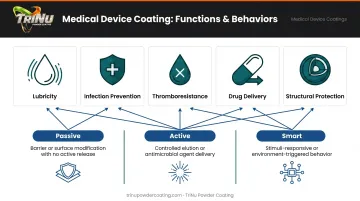
- Medical device coatings serve distinct functions: lubricity, infection prevention, thromboresistance, drug delivery, and physical protection
- Coating selection depends on device placement — body-contact coatings are FDA-regulated; external equipment coatings are not
- Biocompatibility testing to ISO 10993 is required for any coating that contacts the body or bodily fluids
- Surface preparation is as important as the coating itself — poor prep leads to delamination and premature failure
- External equipment frames typically use industrial-grade coatings like powder coating for durability, chemical resistance, and cleanability
What Are Medical Device Coatings?
Medical device coatings are thin layers of functional material applied to device surfaces to enhance performance, safety, biocompatibility, or durability. The term "medical device" spans a wide range — from internal devices like catheters, stents, and implants to external equipment like imaging system housings, hospital carts, and surgical table frames.
Body-Contact vs. External Equipment Coatings
The two categories carry very different regulatory and performance requirements:
- Body-contact coatings (catheters, stents, implants) are regulated as part of the device itself. They require biocompatibility testing under ISO 10993, and changes to coating formulation may trigger new FDA submissions
- External equipment coatings (frames, housings, carts) focus on durability, cleanability, and corrosion resistance — important for infection control, but not subject to the same biological evaluation requirements
Coating Behavior Categories
Coatings also vary by how they interact with their environment:
- Passive — create a barrier or reduce friction without biological interaction
- Active — release a drug or antimicrobial agent over time
- Smart — respond dynamically to environmental triggers like pH or temperature
Most manufacturers work with passive or active coatings. Smart coatings are still in development or early clinical trials — promising, but not yet standard in most applications.
Why Are Medical Devices Coated? The Key Functions
Different coatings solve different clinical problems. Here's a breakdown of the five primary functions:
Lubricity and Friction Reduction
Catheters, guidewires, and introducers must navigate narrow vessels and passages with minimal trauma. Lubricious coatings reduce the coefficient of friction, allowing devices to move smoothly and reducing the risk of vessel injury or patient discomfort.
The performance gains can be substantial. Biocoat's internal research shows that devices coated with HYDAK hydrophilic coatings routinely reduce friction force by approximately 95% compared to uncoated devices — based on manufacturer testing on specific device types.
Infection and Biofilm Prevention
Healthcare-associated infections (HAIs) are among the most serious complications of hospital care. AHRQ data puts the US burden at 1.7 million HAIs and 99,000 deaths annually, with an estimated $28–33 billion in excess healthcare costs. About 75% of hospital-acquired urinary tract infections are linked to urinary catheters, according to the CDC.
Antimicrobial coatings on catheters, IV lines, and implants inhibit bacteria from colonizing device surfaces and forming biofilm. A 2005 randomized trial found that chlorhexidine-silver sulfadiazine-coated CVCs reduced catheter colonization from 33% to 12% — though a 2017 review notes that efficacy varies considerably by agent, device type, and dwell time.
Anti-Thrombogenic Protection
When a foreign device contacts blood, the body's natural response is clot formation. Anti-thrombogenic coatings modify surface chemistry to repel platelets and reduce activation of the coagulation cascade.
Heparin-bonded surfaces carry the strongest clinical evidence. Studies on Carmeda BioActive Surface show measurably better platelet preservation compared to uncoated circuits in simulated extracorporeal circulation — a critical outcome for ventricular assist devices, dialysis catheters, and extracorporeal circuits where clot formation poses life-threatening risks.
Drug Delivery at the Site
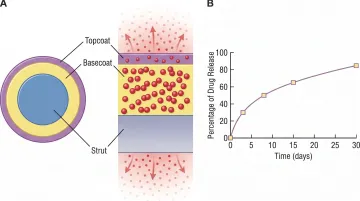
Some coatings function as localized drug-delivery systems, releasing therapeutic agents directly at the treatment site. Drug-eluting stents (DES) are the most thoroughly studied application.
The 2002 RAVEL trial compared sirolimus-eluting stents with standard bare-metal stents in 238 patients. At six months, restenosis was 0% in the sirolimus-stent group versus 26.6% in the bare-metal group. The 2021 ACC/AHA/SCAI guidelines now recommend DES over bare-metal stents for most patients undergoing percutaneous coronary intervention.
Structural Protection and Corrosion Resistance
Not all medical coatings are applied to implants or devices that enter the body. External equipment — imaging systems, surgical tables, hospital carts, device housings — requires coatings engineered for a different set of demands: corrosion resistance, tolerance for repeated chemical disinfection, and a cleanable surface that holds up over years of clinical use.
For manufacturers producing metal equipment components destined for medical settings, industrial-grade powder coating delivers a tough, non-porous, chemically resistant finish suited to those demands. It's a practical solution for OEMs and fabricators supplying durable equipment to hospitals and clinical facilities.
Types of Medical Device Coatings
The right coating type depends on where the device is used, what it contacts, and what problem the coating needs to solve.
Hydrophilic Coatings
Hydrophilic coatings are made from water-attracting polymers (typically polyvinylpyrrolidone (PVP) or polyethylene glycol (PEG)). When wetted, these coatings form a slippery hydrated layer that significantly reduces friction.
They're among the most widely used coatings in interventional medicine, with applications across:
- Catheters and guidewires (cardiovascular, urology, neurovascular)
- Endoscopes
- Ureteral stents
Beyond lubricity, hydrophilic formulations can also be engineered to resist biofouling and reduce bacterial adhesion — a combination that makes them useful across multiple clinical goals.
Antimicrobial Coatings
Antimicrobial coatings incorporate agents that kill or inhibit microbial growth on device surfaces. Common active agents include silver nanoparticles, chlorhexidine, and antimicrobial peptides.
Two broad design approaches exist:
- Leaching coatings release antimicrobial agents over time; efficacy depends on agent concentration and duration
- Non-leaching (surface-bonded) coatings are permanently bound to the surface; studies suggest these can match leaching designs in antimicrobial performance without depleting over time
Common applications include urinary catheters, central venous catheters, and orthopedic implants.
Anti-Thrombogenic Coatings
These coatings are essential for any device that contacts blood. They work by modifying surface chemistry to repel platelets and reduce coagulation cascade activation. Common approaches include:
- Heparin-bonded surfaces (best-supported clinical evidence)
- Phosphorylcholine (PC) coatings (established for coronary stents)
- Certain hydrophilic formulations that exhibit thromboresistant behavior
Devices that commonly rely on anti-thrombogenic coatings include vascular grafts, coronary stents, extracorporeal circuits, and dialysis catheters.
Drug-Eluting Coatings
Drug-eluting coatings use polymer or hydrogel matrices to carry and release pharmaceuticals at the treatment site, delivering targeted doses where they're needed.
Beyond coronary stents, active development targets:
- Antibiotic-eluting orthopedic implants (to reduce post-surgical infection)
- Therapeutic wound dressings
- Localized delivery for ophthalmic and urological applications
The core clinical advantage: targeted delivery reduces systemic drug exposure while concentrating therapeutic effect exactly where it's needed.
Protective and Barrier Coatings
Protective coatings shield surfaces from corrosion, moisture, wear, and biological fluid contact.
For implantable and sensitive devices, Parylene is widely used. It's a conformal polymer coating that provides pinhole-free, biocompatible encapsulation critical for protecting sensitive electronics in neural interfaces and other implantable systems.
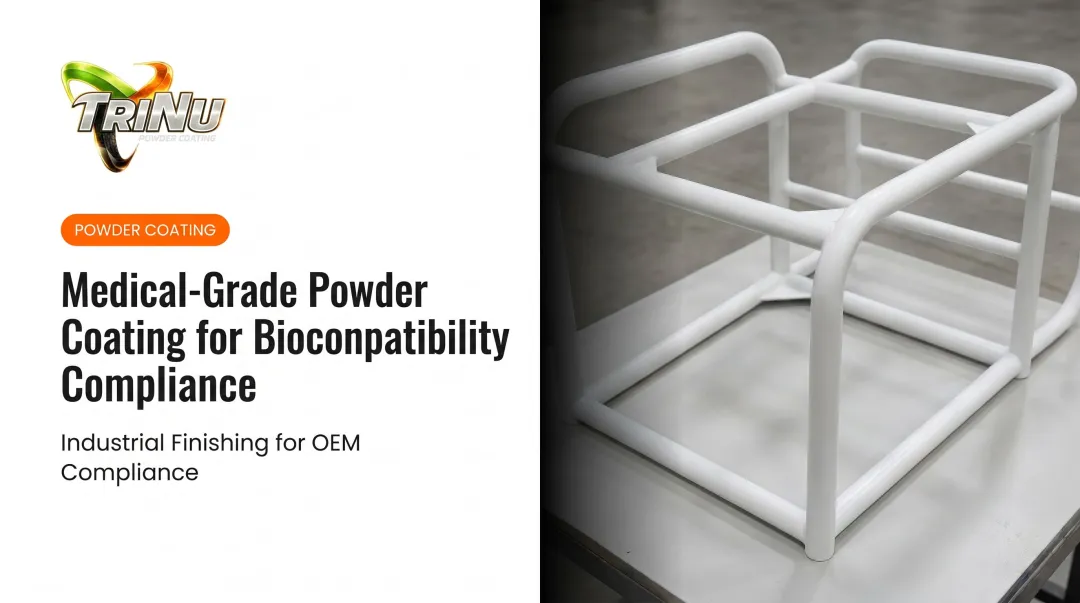
For external medical equipment (frames, housings, carts, structural components), industrial-grade powder coating is the standard. It delivers:
- Tough, non-porous surface resistant to denting and scratching
- Chemical resistance to clinical disinfectants and cleaning agents
- Smooth, cleanable finish that supports infection control protocols
- Long service life in demanding clinical environments

That durability is what makes powder coating a natural fit for high-contact medical environments. TriNu Powder Coating, based in New Port Richey, FL, works with medical device manufacturers and OEMs across the Tampa Bay area on exactly these applications — coating device housings, equipment frames, support carts, cabinet enclosures, and sub-assemblies. With a 10' × 10' × 30' production oven, TriNu can handle oversized medical equipment structures that most finishing shops can't accommodate.
How Are Medical Device Coatings Applied?
Dip Coating
Dip coating involves submerging the device in a coating solution, then withdrawing it at a controlled rate. The typical sequence:
- Surface preparation and cleaning
- Controlled submersion in coating solution
- Controlled withdrawal to build uniform film thickness
- Drying and curing (thermal or UV)
It's the most common process for coating cylindrical devices like catheters and guidewires, where uniform outer-surface coverage is essential.
Spray Coating
Spray coating delivers coating through a nozzle, either manually or via automated systems. It gives more control over film build on complex geometries where full submersion risks pooling or uneven coverage.
For large external equipment components and frames, the standard approach includes:
- Industrial spray systems and powder coating booths
- Electrostatic application for uniform coverage on irregular surfaces
- Oven curing after application to reach full coating performance
Curing Methods
The two primary curing methods for medical device coatings:
| Method | How It Works | Best For |
|---|---|---|
| Thermal / Heat Cure | Oven-based, non-directional heat | Large batches, inner-diameter coatings, external equipment components |
| UV Cure | Directional light chambers | Outer surfaces, faster cycle times |
The curing method affects coating uniformity, production throughput, and whether inner surfaces can be fully cured. For powder-coated external equipment, thermal curing in a production oven is standard — cure verification confirms the coating has reached full performance before parts are released.
Key Considerations When Selecting a Medical Device Coating
Match Coating Function to Device Purpose
Define what the coating must accomplish before specifying a material or process. The five functions — lubricity, infection prevention, thromboresistance, drug delivery, and physical protection — are not interchangeable. A coating optimized for friction reduction may offer no antimicrobial benefit, and vice versa.
Biocompatibility and Regulatory Compliance
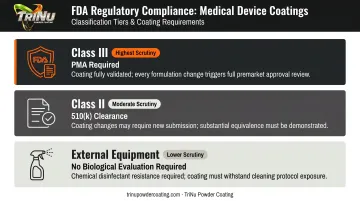
For any coating that contacts the body or bodily fluids, biocompatibility testing per ISO 10993 is required. FDA evaluates coatings based on contact type (surface, external communicating, or implant) and contact duration. The longer and more intimate the contact, the more testing endpoints apply.
Key compliance considerations:
- Class II devices typically require 510(k) clearance; coating changes may require a new submission
- Class III devices require Premarket Approval (PMA); coatings are validated as part of the device
- External equipment coatings are not subject to biological evaluation, but should resist the chemical disinfectants used in clinical settings
Regulatory compliance and surface quality are closely connected. A coating that meets all biocompatibility requirements will still fail if the substrate beneath it isn't properly prepared.
Surface Preparation and Application Quality
Even the most advanced coating will fail on a poorly prepared surface. Proper surface prep — cleaning, degreasing, and where appropriate, abrasive blasting to create the right surface profile — is what allows a coating to bond and last.
For metal components in medical equipment housings, frames, and external structures, this means working with a finishing partner that:
- Evaluates each part individually before coating
- Uses controlled blasting methods appropriate to the substrate
- Inspects every job before release
For external medical equipment components — where industrial powder coating is the specified finish — TriNu's process covers surface preparation through final cure, with QC Certified Program compliance and documented inspection on every job. That level of traceability supports the documentation requirements common in regulated manufacturing environments.
Frequently Asked Questions
What are the 4 types of coatings?
Coatings are broadly categorized as liquid coatings, powder coatings, specialty coatings (such as Parylene or drug-eluting films), and conversion coatings (such as anodizing or phosphating). Within medical devices, classification shifts to function: lubricious, antimicrobial, anti-thrombogenic, drug-eluting, and protective.
What is the difference between hydrophilic and hydrophobic coatings on medical devices?
Hydrophilic coatings attract water and become slippery when wet, reducing friction for devices navigating body passages. Hydrophobic coatings repel water and fluids, making surfaces resistant to moisture, contamination, and bacterial adhesion. The right choice depends on the device's primary need — lubricity (hydrophilic) or fluid and contamination resistance (hydrophobic).
Are medical device coatings regulated by the FDA?
Yes. Coatings that contact the body are regulated as part of the device and must meet FDA requirements, including biocompatibility testing per ISO 10993. Class II and Class III devices require coating validation as part of clearance or approval, and post-clearance formulation changes may trigger a new submission.
What coating is commonly used on catheters?
Hydrophilic coatings are the most common choice — they reduce friction when wet, making insertion and navigation easier with less patient discomfort. Antimicrobial coatings using silver or chlorhexidine are also applied to urinary and central venous catheters to reduce infection risk.
What is the role of surface preparation in medical device coating?
Surface preparation is foundational to coating performance. It removes contaminants, oxides, and surface irregularities that would otherwise prevent proper adhesion. Poor surface prep leads to delamination, uneven coverage, and premature coating failure — regardless of how advanced the coating material is.
What does drug-eluting mean in medical device coatings?
Drug-eluting means the coating carries a pharmaceutical agent and releases it gradually at the treatment site. Drug-eluting stents are a well-documented example: the coating releases medication after placement to prevent artery re-narrowing, a condition called restenosis.