What is sandblasting and how does it work?
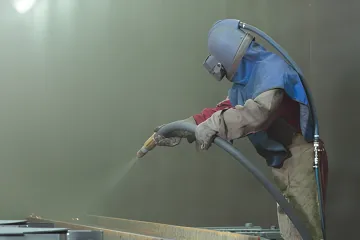
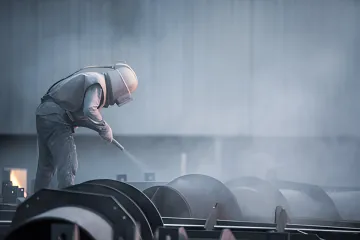
Sandblasting, also called abrasive blasting, uses pressurized air to propel abrasive media (such as sand, grit, or metallic shot) against a surface to remove rust, coatings, scale, and contaminants. The process creates a clean, textured anchor profile that maximizes coating adhesion and long-term durability. Different media types are selected based on substrate material, desired surface profile depth, and coating specifications. Our controlled blasting parameters ensure consistent results while preserving substrate integrity.
What surfaces can be sandblasted?
We sandblast a wide range of metal surfaces including steel, aluminum, stainless steel, cast iron, and specialty alloys used in industrial fabrication, architectural applications, and manufacturing. The process is ideal for structural components, machinery parts, railings, equipment housings, and large-scale assemblies. Surface preparation is customized based on material type, existing condition, and downstream coating requirements. Non-metal substrates like concrete or stone require specialized equipment and are evaluated on a project-by-project basis.
How long does the sandblasting process take?
Turnaround time depends on project size, surface condition, component complexity, and current production schedule. Typical small to medium projects are completed within 3-5 business days. Larger industrial jobs or components requiring specialized preparation protocols may take 7-10 days. We provide realistic timelines upfront and communicate proactively throughout the process. Our pick-up and delivery service throughout Hillsborough County helps minimize disruption to your production schedule.
What's the difference between sandblasting, shot blasting, and grit blasting?
The primary difference is the abrasive media used and the resulting surface profile. Sandblasting uses fine silica or alternative media for general cleaning and light profiling. Shot blasting uses spherical metallic shot for uniform surface finishing and peening effects that improve fatigue resistance. Grit blasting uses angular media for aggressive removal and deep anchor profiles needed for high-performance coatings. Media selection is based on substrate material, existing surface condition, and the coating system's anchor profile requirements.
How much does sandblasting cost in Hillsborough County?
Pricing is based on surface area, component size, material type, existing coating or contamination levels, and required surface profile specifications. Simple cleaning of small parts starts around a few hundred dollars, while large structural components or heavily corroded surfaces require detailed assessment. We provide transparent, itemized quotes after evaluating your specific project requirements. Fair pricing has been a core commitment since 2017—we focus on delivering value through proper preparation and durable results, not cutting corners.
Do you offer pick-up and delivery service?
Yes, we provide convenient pick-up and delivery throughout the Tampa Bay area, including all of Hillsborough County, Clearwater, Tarpon Springs, and New Port Richey. This service is designed to support manufacturers and fabricators by minimizing downtime and logistical complexity. Components are transported securely, processed according to specifications, inspected before release, and returned ready for assembly or installation. Transportation costs are included in project quotes based on location and load size.
Will sandblasting damage my parts or materials?
When performed correctly with appropriate media selection and controlled pressure settings, sandblasting does not damage substrates—it prepares them for optimal coating performance. Our 20+ years of experience ensures blasting parameters are calibrated for each material type and project requirement. Thin materials, soft metals, or precision-machined surfaces receive adjusted protocols to prevent warping or dimensional changes. Every job undergoes pre-blast evaluation and post-blast inspection to verify surface integrity and profile specifications are met.
Can sandblasting be combined with powder coating?
Absolutely—combining sandblasting with powder coating is one of the most effective ways to ensure long-lasting, durable finishes. Proper surface preparation through sandblasting removes all contaminants and creates the anchor profile needed for maximum coating adhesion. We handle both processes in-house with seamless coordination: sandblast, clean, apply powder coating in our controlled environment, and cure in our 10' × 10' × 30' production oven. This integrated approach eliminates logistics, reduces turnaround time, and ensures quality control throughout the entire finishing process.