Introduction
For OEM manufacturers, the surface finish is often the last step — and the one most likely to cause downstream problems. Parts that pass every prior quality gate can still fail inspection or generate warranty claims because of a coating that didn't hold up.
Powder coating's real value in a manufacturing context isn't just durability — it's production consistency, reduced rework, and field performance that holds up to what you promised your customer.
What follows covers what powder coating actually delivers for manufacturers and fabricators: the operational results, the failure modes it prevents, and the production metrics where it makes a measurable difference.
TL;DR
- Powder coating is an electrostatically applied, thermally cured finish — harder, more durable, and more protective than liquid paint
- For OEMs, the core value is corrosion resistance, batch-to-batch consistency, and finish reliability that supports tight production schedules
- Inadequate prep, inconsistent curing, or missing inspection leads to field failures, rework costs, and supply chain disruption
- Choosing the right coating partner means evaluating process documentation, surface prep capability, oven capacity, and pre-release inspection before price
What Is Powder Coating for OEM Parts?
Powder coating is a dry finishing process. A polymer resin powder — combined with pigments, curatives, and flow modifiers — is electrostatically charged and applied to a grounded metal part. The part then enters a curing oven where heat triggers a chemical reaction, forming cross-linked molecular chains that bond to the metal surface. The process uses no solvents, no liquid carriers, and produces no VOCs.
According to the Powder Coating Institute, powder coating represents more than 15% of the total industrial finishing market — and the adoption is driven by performance, not just environmental preference.
Where It's Used in OEM Manufacturing
Powder coating appears across virtually every segment of industrial manufacturing:
- Structural components and fabricated assemblies
- Equipment housings, frames, and enclosures
- Machine guards, skid bases, and control cabinets
- Brackets, sub-assemblies, and production hardware
- Any metal part requiring long-term protection before it ships to the end customer
The key point: powder coating is a process outcome, not just a material. The durability and appearance of the final finish are only as good as the surface preparation, application control, and curing parameters behind it. A quality powder applied over a poorly prepped surface will fail — which is why OEMs evaluating a finishing partner should ask about the process, not just the product.
Key Advantages of Powder Coating for OEM Parts
The three advantages below map directly to outcomes OEM manufacturers track: product lifespan, rework rates, and production reliability. Each maps to how powder coating actually performs in manufacturing and field environments.
Long-Term Corrosion and Wear Resistance
Powder coating creates a seamless, cross-linked film barrier (typically 50 to 100 microns thick on industrial parts) that resists moisture penetration, chemical exposure, salt, UV degradation, and mechanical abrasion. The electrostatic application process wraps powder into edges, recesses, and complex geometries, ensuring the entire part surface is protected, not just the flat faces a spray gun can reach directly.
NACE's IMPACT study estimated the global cost of corrosion at $2.5 trillion annually, roughly 3.4% of global GDP, and identified that 15–35% of those costs could be avoided with available corrosion-control practices. Powder coating is one of those practices.
For OEM manufacturers, the financial exposure isn't abstract. Field failures from coating breakdown (rust bleed-through, delamination, surface degradation) generate warranty claims and customer complaints that cost far more than the finishing step itself. And when a coated part fails in the field, the brand reputation of the manufacturer takes the hit, not just the coater.
KPIs impacted: product warranty claims, field failure rates, customer satisfaction scores, total cost of ownership
When it matters most: Parts exposed to outdoor environments, moisture, road salt, industrial chemicals, or high-humidity operating conditions — common in transportation, agricultural, construction, and industrial equipment manufacturing.
Consistent, Repeatable Finish Quality Across Production Runs
For OEMs producing parts in volume, batch-to-batch consistency is a quality control requirement. Color, gloss, film thickness, and adhesion must match spec across every part, every run, every time. A controlled powder coating process achieves this through standardized surface prep, calibrated electrostatic application, and verified oven temperature profiles — eliminating the variability common in liquid paint systems.
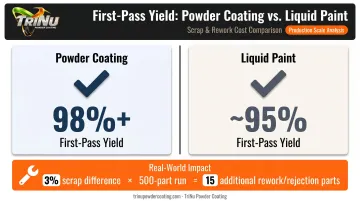
Products Finishing reports that powder coating systems typically achieve 98%+ first-pass yield, compared to approximately 95%+ for liquid coating. That gap compounds quickly at production volume: a 3% difference in scrap rate across a 500-part run means 15 additional parts requiring rework or rejection.
Inconsistent finishes create downstream problems:
- Parts fail visual or adhesion inspection, stalling the production line
- Rework costs compound across the entire batch
- OEM buyers and tier suppliers who receive inconsistently finished components raise quality holds or require corrective action plans
Both outcomes damage long-term supplier relationships.
KPIs impacted: first-pass inspection rate, rework and rejection rates, batch-to-batch color and gloss deviation, supplier quality scorecards
When it matters most: Tier supplier relationships, products with visible finished surfaces, and programs where multiple batches must match over an extended production period.
Production Reliability and Process Efficiency
For OEMs, the finishing step is often a scheduling bottleneck. Parts waiting on coating hold up downstream assembly, packaging, and shipping. A powder coating partner whose process is predictable — and whose capacity matches production volume — removes that bottleneck from the schedule.
A structured coating operation delivers this through defined process steps: surface prep → coat → cure → inspect → release. Large-format oven capacity handles volume without batching delays. Clear turnaround windows give production schedulers something to plan around.
TriNu Powder Coating's 10' × 10' × 30' production oven (one of the largest powder coating capacities in the Tampa Bay area) is built specifically to handle OEM volume, including oversized fabrications and long structural parts that most coating shops can't accommodate.
Finishing delays that push assembly schedules carry real cost: missed ship dates, idle downstream labor, and expedite fees. When coating is applied consistently and inspected before release, parts don't come back. Every returned part represents not just material cost, but scheduling disruption and lost capacity.
KPIs impacted: on-time delivery rate, production cycle time, rework and return rate, finishing cost per unit
When it matters most: Manufacturers running tight schedules, OEMs with regular production programs, and operations where coating is a defined step in a larger assembly sequence.
What Happens When Powder Coating Quality Is Ignored
When OEMs select coating vendors based on price alone — or use coaters without documented surface prep, curing verification, or inspection processes — quality failures don't show up at the finishing stage. They show up later, when they're harder and more expensive to fix.
The common consequences:
- Coating peels or blisters in the field within the first season of use, triggering warranty events before the product has paid for itself
- Undertreated or improperly cured parts fail at the OEM's assembly line, stalling production and requiring rework or recoating
- Parts ship without a final inspection step — and the defect surfaces at the customer's facility, which is typically more expensive to resolve than catching it at the coater
- Rework, returns, and warranty service turn an apparent cost savings into a budget liability
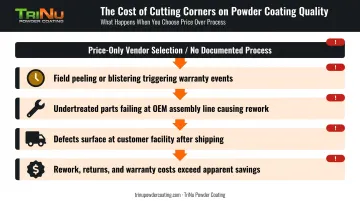
Surface preparation is consistently identified as the most influential factor in coating adhesion and longevity — and it's the step most commonly cut when a coater is competing on price.
The risk compounds at scale. A quality problem with one batch affects a small run. The same problem in a production program affects every delivery until the root cause is found and corrected. By then, the relationship damage is often already done.
How to Get the Most Value from Your Powder Coating Partner
Powder coating works best for OEMs when it's treated as an integrated production step — not a commodity outsource. The right partner is selected based on process capability, not just availability and price.
What to Evaluate in a Coating Partner
| Evaluation Area | What to Look For |
|---|---|
| Surface prep capability | Documented blasting process, chemical pretreatment options, material-specific prep procedures |
| Oven capacity | Large enough to handle your part size and volume without batching delays |
| Inspection process | Defined pre-release inspection — not just visual, but documented |
| Turnaround reliability | Clear windows that production schedulers can plan around, not estimates that shift |
| Communication | Status updates without chasing — you know where your parts are |
TriNu Powder Coating offers pickup and delivery throughout the Tampa Bay area, with a process that includes verified prep, controlled application, and per-job inspection before release. The workflow — from surface preparation through final cure — is designed to support manufacturers and fabricators on regular production programs, with turnaround windows that can be built into a production schedule.
OEMs who establish a reliable coating partnership consistently see the same outcomes:
- Fewer rework cycles and rejected parts at final inspection
- Predictable lead times that production schedulers can actually plan around
- A finished product that reflects well on their own brand
When the finishing step is controlled rather than unpredictable, it stops absorbing margin and starts reinforcing it.
Conclusion
Powder coating's value for OEM manufacturers isn't primarily about the material — it's about control, consistency, and the ability to produce the same quality finish at volume, every time.
The three advantages covered here — corrosion resistance, finish consistency, and production reliability — compound over time when the coating process is executed correctly and treated as an integrated manufacturing step. When the process isn't controlled, those same advantages erode fast.
For manufacturers and fabricators who need a finishing partner that shows up consistently and delivers parts ready for the next production step, the coater's process matters more than their price. TriNu Powder Coating has spent 20+ years building that process — from surface prep through final cure — for OEM and industrial customers across the Tampa Bay area. If consistent results and reliable turnaround are what your production schedule depends on, that's where the conversation starts.
Frequently Asked Questions
How much does it cost to powder coat OEM parts?
Cost varies based on part size, quantity, surface condition, and prep requirements. OEM production runs are typically priced per part with volume factored in.
Can you powder coat automotive and vehicle components?
Powder coating is widely used on vehicle components — frames, brackets, suspension parts, wheels, and underhood hardware. Proper surface prep and powder selection for the specific part and heat exposure are the key variables for a lasting result.
How long does powder coating last on OEM parts?
Properly applied powder coating on prepared metal can last many years under normal operating conditions, with corrosion resistance and UV stability well beyond conventional paint. Longevity depends on surface prep and curing quality as much as powder formulation.
What's the difference between powder coating and liquid paint for industrial parts?
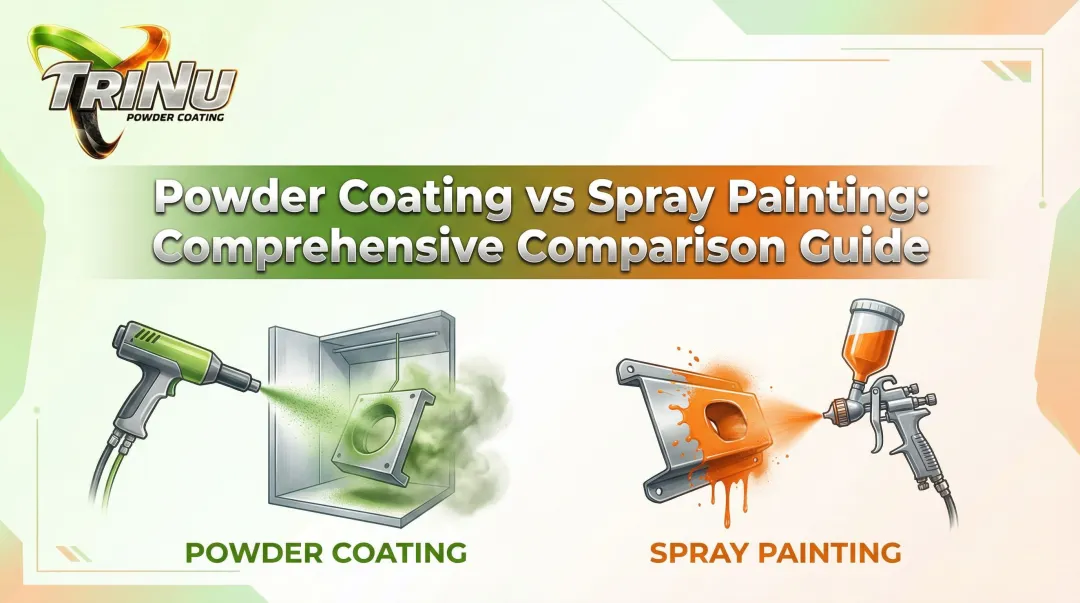
Powder coating forms a harder, thicker, solvent-free film that resists chipping, corrosion, and chemical exposure better than liquid paint. It produces no VOCs, allows overspray recovery, and delivers more consistent results at production scale.
How does surface preparation affect powder coating quality?
Surface prep — cleaning, blasting, and chemical pretreatment — is the single most important factor in coating adhesion and longevity. Contamination or insufficient surface profile is the leading cause of premature coating failure in industrial applications.
What types of OEM parts are best suited for powder coating?
Powder coating suits virtually any metal part needing durable, consistent protection: steel assemblies, aluminum components, frames, enclosures, brackets, and structural hardware. Parts with complex geometries are a particularly strong fit — electrostatic application reaches edges and recesses that liquid spray systems routinely miss.
![How Much Does Powder Coating Rims Cost in [2026]?](https://file-host.link/website/trinupowdercoating-kp0fq9/assets/blog-images/8bbea572-74a2-4565-ac79-98d10efdd7b2/1775735510944005_3d500529eea04ea1be6801bc61067eb1/1080.webp)