
None of that is speculative. The exposure data exists. The regulatory framework is clear. What's less consistent is how operations apply it.
Skipping engineering controls doesn't just put the blaster at risk — it exposes pot tenders, nearby tradespeople, and cleanup crews. Production delays from worker illness, OSHA violations from inadequate containment, and hazardous waste disposal costs from unmanaged spent media all follow from the same root cause: treating safety as an add-on rather than a built-in requirement.
This guide covers the primary hazards, the PPE and engineering controls required by OSHA, the most common operational mistakes, and what a properly controlled blasting program actually looks like in practice.
TL;DR
- Abrasive blasting in shipyards creates toxic dust, extreme noise (up to 145 dB(A)), high-pressure mechanical hazards, and confined-space risks — all requiring active controls
- Silica sand is largely phased out due to silicosis risk; garnet, coal slag, and steel grit alternatives still carry heavy metal exposure that requires monitoring
- NIOSH-certified Type CE airline respirators are mandatory in enclosed spaces; full PPE — blast helmet, hearing protection, gloves, boots, and fall arrest — is required throughout
- Engineering controls (enclosures, ventilation, exclusion zones) come first; PPE supplements them but never replaces them
- Pre-blast atmospheric testing in confined spaces and HEPA-vacuum cleanup protocols are non-negotiable, not optional steps
Key Hazards of Abrasive Blasting in Shipyard Environments
Airborne Dust and Toxic Contaminants
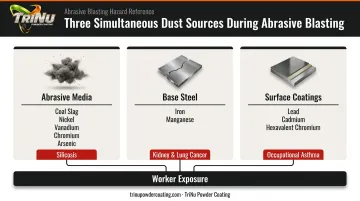
The dust generated during abrasive blasting doesn't come from one source — it comes from three simultaneously:
- The abrasive media itself — coal slag releases nickel, vanadium, chromium, and sometimes arsenic
- The base steel — releases iron, manganese, and other metals depending on alloy composition
- Surface coatings being removed — old marine paints frequently contain lead, cadmium, and hexavalent chromium
NIOSH field measurements at Avondale Shipyards found small-particle total particulate outside blast hoods ranging from 34.6 to 64.1 mg/m³, lead concentrations of 1–260 µg/m³, and arsenic up to 50 µg/m³. These aren't worst-case projections — they're measured exposure levels from actual blasting operations.
The disease consequences are permanent and well-documented:
- Crystalline silica — causes silicosis, an irreversible lung-scarring condition with no cure
- Cadmium — causes kidney damage and lung cancer
- Hexavalent chromium — causes occupational asthma and nasal tissue damage
Exposure risk doesn't stop at the nozzle operator. Pot tenders and cleanup crews face significant airborne contamination from the same operation.
Noise Hazards
OSHA's shipyard blasting guidance documents nozzle air discharge levels of 112–119 dB(A), with peaks reaching 145 dB(A) when grit pots run empty. For context, OSHA's permissible exposure limit is 90 dB(A) as an 8-hour average, with a hearing conservation action level at 85 dB(A).
Blasting inside tanks, holds, and enclosed vessel sections amplifies these levels through reflection. Unprotected exposure causes permanent hearing loss — not temporary threshold shifts, but irreversible damage.
Physical, Mechanical, and Confined-Space Hazards
Noise and airborne exposure are chronic risks. Mechanical hazards are immediate:
- High-velocity abrasive particles can embed in skin, cause severe eye damage, and produce deep cuts
- Hose coupling failures cause serious injuries — a 2006 OSHA accident report documents a coupler failure that struck a worker, resulting in multiple femur fractures
- Static electricity from blasting equipment can ignite flammable atmospheres, particularly in enclosed vessel spaces that may have contained fuel or chemical cargo
- Heat stress from full blast PPE in Florida's humidity is a genuine operational risk
- Pressure surges can throw blasters off elevated work surfaces, creating fall hazards
Confined space blasting — inside cargo tanks, pump rooms, and engine rooms — compounds every risk on this list. Limited ventilation concentrates contaminants faster, spark conditions meet flammable residues, and oxygen displacement happens without visible warning.
Safety Guidelines for Shipyard Abrasive Blasting
No single control is sufficient on its own. Safe blasting depends on layered measures — engineering controls lead, followed by administrative practices, then personal hygiene, with PPE serving as the last line of defense. Conditions also change as work moves between hull exteriors, confined tank spaces, and drydock positions — controls must be reassessed at each transition, not set once and forgotten.
General Safety Precautions
Respirator requirements depend on the work environment and abrasive media:
- Enclosed or confined spaces, or media with more than 1% crystalline silica: NIOSH-certified Type CE abrasive blasting airline respirator — mandatory, no exceptions
- Open-air blasting with verified low-silica abrasives (under 1% crystalline silica): air-purifying respirator with HEPA filters, combined with eye, face, and head protection
**Full PPE for all blasting operators** under 29 CFR 1915.34 and 1915.152–1915.156:
- Blast helmet or head protection
- Heavy canvas or leather gloves and aprons
- Safety boots
- Hearing protection (to maintain exposure below 90 dB(A))
- Fall protection where guardrails cannot be provided
Personal hygiene controls directly limit off-site contamination. Prohibit eating, drinking, and applying cosmetics in blasting areas, and require handwashing before leaving the work area. When lead or hexavalent chromium is present, workers must shower and change into clean clothes before leaving the site — toxic dust carried home on clothing and skin contaminates vehicles and living spaces.
Site Setup and Containment
The enclosure hierarchy, from most to least controlled:
- Sealed blasting cabinets for small components — best containment
- Ventilated blasting rooms for mid-size transportable objects
- Temporary enclosures around large structures or ship hulls, blasting downward when full enclosure isn't feasible
- Exclusion zones with posted signage when open-air blasting is unavoidable — avoid windy conditions that defeat containment
Per 29 CFR 1910.94(a), all blast-cleaning enclosures must maintain continuous inward airflow at openings, exhaust through a dust collector to the outside, and prevent dust from accumulating or leaking into adjacent work areas.
Abrasive selection is a safety decision, not just a procurement one. Silica sand — nearly 100% crystalline silica — should not be used. Common alternatives carry their own risk profiles:
| Abrasive | Primary Concerns |
|---|---|
| Coal slag | Chromium, nickel, vanadium, sometimes arsenic |
| Copper slag | Trace arsenic, copper, lead |
| Garnet | Less than 0.1% crystalline silica; low heavy metal profile |
| Steel grit/shot | Iron, manganese; review primer/coating contamination |
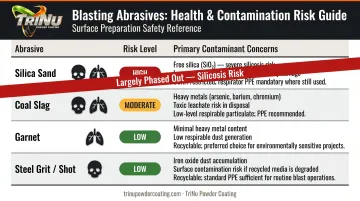
Every media-and-coating combination is its own exposure profile. SDS review and air monitoring are required for every media-coating combination — there are no blanket safe choices.
Safe Operation Practices
A dead-man control at the nozzle is required for all blasting operations. This device automatically shuts off blasting if the operator loses grip or control — its presence is non-negotiable.
Scheduling and isolation:
- Schedule blasting when the fewest non-essential workers are present
- Stop adjacent work and clear the area during active blasting
- Enforce exclusion zones with barriers and signage — not just verbal instructions
Monitoring during operation: Conduct air sampling outside enclosures to verify that non-blasting workers aren't being exposed. OSHA mandates exposure monitoring whenever operations may expose workers to arsenic, cadmium, hexavalent chromium, or lead. If elevated levels are detected outside the containment, stop work and correct controls before resuming.
Cleanup protocols:
- Use HEPA-filtered vacuums or wet methods — never compressed air blowdown, which resuspends settled dust
- Remove paint chips, spent abrasive, and accumulated dust daily or immediately after blasting ends
- Test spent abrasive for RCRA toxicity characteristics if contaminated with lead or heavy metals; disposal must comply with EPA hazardous waste requirements under 40 CFR 261.24
Environmental and Confined Space Considerations
Blasting inside cargo tanks, engine rooms, pump rooms, or storage lockers requires compliance with 29 CFR 1915 Subpart B before anyone enters. Under 1915.12, atmospheric testing must follow this sequence:
- Oxygen level — safe range is 19.5% to 22.0%
- Flammable/combustible gases — must be below 10% of the lower explosive limit
- Toxic contaminants — must be within PEL or below IDLH limits
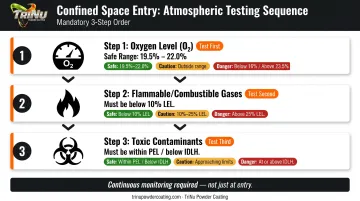
Continuous monitoring is required during the work, not just at entry. Under 1915.15, employers must maintain safe conditions throughout the operation — retesting or monitoring must be frequent enough to confirm conditions haven't changed.
Static electricity control is equally critical in confined spaces. All blasting equipment, ventilation ductwork, and work surfaces generate static charge during operation. Bond and ground all equipment. Blast hoses must include anti-static linings or ground wire. In enclosed vessel spaces with any history of fuel or chemical cargo, an uncontrolled static discharge can trigger an explosion.
Common Safety Mistakes to Avoid
These three failures account for a disproportionate share of serious injuries and regulatory violations in shipyard blasting:
1. Continuing to use silica sand — or assuming low-silica alternatives carry no silica risk. NIOSH recommended against silica sand abrasives containing more than 1% silica as far back as 1974. The disease it causes, silicosis, is incurable. Even alternative abrasives used in enclosed or confined spaces can produce hazardous airborne concentrations if silica content isn't verified through SDS review and air monitoring.
2. Relying on PPE before engineering controls are in place. Respirators protect the person wearing them. They do nothing for the pot tender, the nearby welder, or the cleanup crew working without PPE in the same contaminated area. 29 CFR 1910.134(a) is explicit: engineering controls — enclosure, ventilation, substitution — come first. Respirators fill the gap when those controls are infeasible or still being established.
Reversing this priority isn't just a compliance failure. It leaves entire work areas unprotected — including workers who never put on a respirator at all.
3. Skipping atmospheric testing before entering confined spaces. Residual fuel vapor, previous cargo contamination, and oxygen displacement from blasting itself can create explosive or immediately dangerous atmospheres with no visible sign. No monitoring equipment means no warning. Atmospheric testing before entry is required under OSHA's confined space standards — and it's the only way to confirm whether conditions are safe before workers are already inside.
Conclusion
Safe abrasive blasting in shipyards requires every control layer to hold: enclosures, ventilation, abrasive selection, full PPE, atmospheric monitoring before and during confined-space work, and proper cleanup. These controls aren't redundant — each one covers a gap the others don't. Shortcutting any single element creates cascading exposure across workers, bystanders, and surrounding operations.
OSHA's 29 CFR 1915 Subpart C and related standards should function as working references tied to job hazard analyses and permit workflows — not one-time compliance checklists reviewed at orientation and filed away.
When surface preparation and coating work needs to meet documented standards, the process discipline behind the blast matters as much as the coating that follows. TriNu Powder Coating, based in the Tampa Bay area, runs a structured workflow from initial part inspection and media selection through controlled blasting and quality verification before any part is released — with marine-grade capability and 20+ years supporting coastal Florida fabricators.
Frequently Asked Questions
What are the health and safety hazards of abrasive blasting for shipyard workers?
Shipyard blasting exposes workers to several serious hazard categories:
- Toxic dust: silicosis from silica, lead poisoning, cadmium and hexavalent chromium exposure
- Noise: levels exceeding 119 dB(A) causing permanent hearing loss
- Mechanical: high-pressure injuries from hose and coupling failures
- Environmental: static electricity, heat stress, oxygen deficiency, and explosive atmospheres in confined spaces
What types of abrasives are used in shipyard abrasive blasting?
Silica sand has largely been replaced due to silicosis risk. Common alternatives include garnet (low crystalline silica, generally below 0.1%), coal slag, copper slag, and steel grit or shot. Each carries a distinct heavy metal exposure profile that must be evaluated through SDS review, bulk analysis, and personal air monitoring before use.
What PPE is required for shipyard abrasive blasting operators?
In enclosed or confined spaces, operators must use NIOSH-certified Type CE abrasive blasting airline respirators. Operators also require:
- Hearing protection and blast helmets
- Heavy canvas or leather gloves and aprons
- Safety boots and fall protection where applicable
These requirements fall under 29 CFR 1915 Subpart I and 1915.34.
Is silica sand still used in shipyard blasting?
Most shipyards have phased it out. NIOSH recommended against abrasives with more than 1% crystalline silica in 1974 due to documented silicosis risk. OSHA strongly recommends safer alternatives — though those alternatives still require evaluation for their own heavy metal content and airborne exposure profiles.
What are the OSHA regulations for abrasive blasting in shipyards?
Core standards include 29 CFR 1915 Subpart C (surface preparation), 1915.34 (mechanical paint removers), 1910.134 (respiratory protection), and 1910.94 (ventilation). Substance-specific standards for lead, arsenic, hexavalent chromium, and cadmium are covered under 29 CFR 1915.1018–1915.1027.
How much does abrasive blasting for shipyards cost?
Costs vary based on vessel size, surface area, abrasive type, containment requirements, and location. Project budgets should account for abrasive consumption, recycling potential, containment cleanup labor, spent media disposal costs (which can escalate under RCRA when lead or heavy metals are present), and pot-refill downtime — not just media price per ton.